ICHRA is helping many employers offer health coverage for the first time, rather than simply replacing traditional group plans.
ICHRA gives employees access to a broader range of health plan options, allowing employers to offer more flexible, individualized coverage.
Rising healthcare costs and workforce fragmentation continue to strengthen the case for defined-contribution health benefits.
Market volatility and carrier exits are creating new opportunities for regional and growth-focused health plans.
Health plans that invest in partnerships, operational readiness, and market education today will be better positioned as ICHRA adoption grows.
AHIP 2026 is one of the events that I make sure to attend every year. It spans so many topics in different corners of the healthcare ecosystem that you end up in a room full of very different and sometimes contradictory perspectives.
I’m going to focus on the Individual Coverage Health Reimbursement Arrangement (ICHRA) conversations that made an appearance in most Individual market sessions. What stood out most was the acknowledgement that many organizations are still figuring out how to move from pilot programs to a scalable, long-term strategy.
ICHRA Is Helping Employers Offer Coverage Where None Existed Before
One of the strongest themes from Softheon’s AHIP Lunch & Learn, Connecting the ICHRA Ecosystem to Close Coverage Gaps, was that ICHRA’s growth story is often misunderstood. The conversation is frequently framed around employers moving employees from traditional group plans to the Individual market. But the data suggests another opportunity.
During the session, Softheon Chief Growth Officer Kevin Deutsch pointed to HRA Council data showing that many employees gaining coverage through ICHRA previously had no employer-sponsored option available.
“83% of individuals that are enrolling in ICHRA come from employers where there was no previous coverage offered. And so when you think about the opportunity in ICHRA to close coverage gaps, it certainly exists because it was unaffordable previously for employers.” – Kevin Deutsch, Chief Growth Officer at Softheon
That’s an important distinction. For many small and midsized employers, the challenge has never been a lack of interest in offering benefits. It’s been affordability, administrative complexity, and the difficulty of managing a traditional group health plan. Annual renewals, participation requirements, contribution strategies, compliance obligations, and rising premiums have put employer-sponsored coverage out of reach for many organizations and their human resources departments.
ICHRA creates a different model. Instead of sponsoring a group plan, employers provide a defined contribution that employees can use to purchase Individual market coverage. That approach gives employers more predictable healthcare spending while giving employees the ability to select coverage that best fits their needs, providers, and budget.
As healthcare costs continue to rise and workforces become more distributed, that flexibility is becoming increasingly attractive. Rather than replacing coverage that already exists, ICHRA is helping employers offer coverage for the first time, bringing in new individuals who may have otherwise remained uninsured.
This is more important today than ever. PwC released a new analysis that projects the highest medical cost trend in nearly 20 years. The projected 9% rise in commercial health costs will place a strain on employees and their employers. In a market where small and mid-sized employers, especially, are struggling to provide comprehensive benefits to their employees, a 9% jump could drive many out of the traditional group market.
Workforce Trends Are Reshaping How Coverage Is Delivered
One of the most interesting parts of the discussion was about the broader trends changing how people work, shop, and consume healthcare.
“We know that trends with workforce fragmentation and people hiring from different areas of the country… they’re unlikely to shift back to always going into an office at all times.” – Nancy Wise, President and Founder, Spring Street Exchange
That observation showed up repeatedly throughout AHIP. Employers are hiring across multiple states. Remote and hybrid work arrangements have become a permanent part of the workforce. Employees increasingly expect flexibility and personalization in nearly every aspect of their lives, including healthcare coverage. Kevin Deutsch connected those trends directly to ICHRA.
“5 in 10 jobs are remote capable, meaning that companies are hiring across the country.” – Kevin Deutsch, Chief Growth Officer at Softheon
Traditional group plans were built for a workforce that was more centralized and more uniform. Today’s workforce looks very different. Employees may be spread across multiple markets, have different provider preferences, and face different healthcare needs.
That doesn’t mean group coverage is going away. It does mean employers are evaluating whether there are alternative ways to provide benefits that better align with a distributed workforce. As consumer expectations continue to rise and workforce models continue to evolve, it’s easy to see why more organizations are taking a closer look at ICHRA as part of their long-term benefits strategy.
Kevin Deutsch, Softheon | Nancy Wise, MBA, MPH, Spring Street Exchange | Joseph Boyle, ClearFile Solutions
Market Disruption Is Creating New Opportunities
One theme that surfaced across multiple AHIP sessions was that disruption in the Individual market isn’t affecting every organization the same way.
During Softheon’s Lunch & Learn, Joe Boyle, President and Founder of ClearFile, argued that market exits should not automatically be viewed as a negative development for health plans.
“When a large issuer does exit the market, it does give the impression to smaller regional provider plans that we should run away too. Well, I believe this is firmly optimistic for plans because at the end of this year, regardless of whoever exits the market, those members and families will be plan matched to the most like plans for the other carriers.” – Joe Boyle, President and Founder, ClearFile
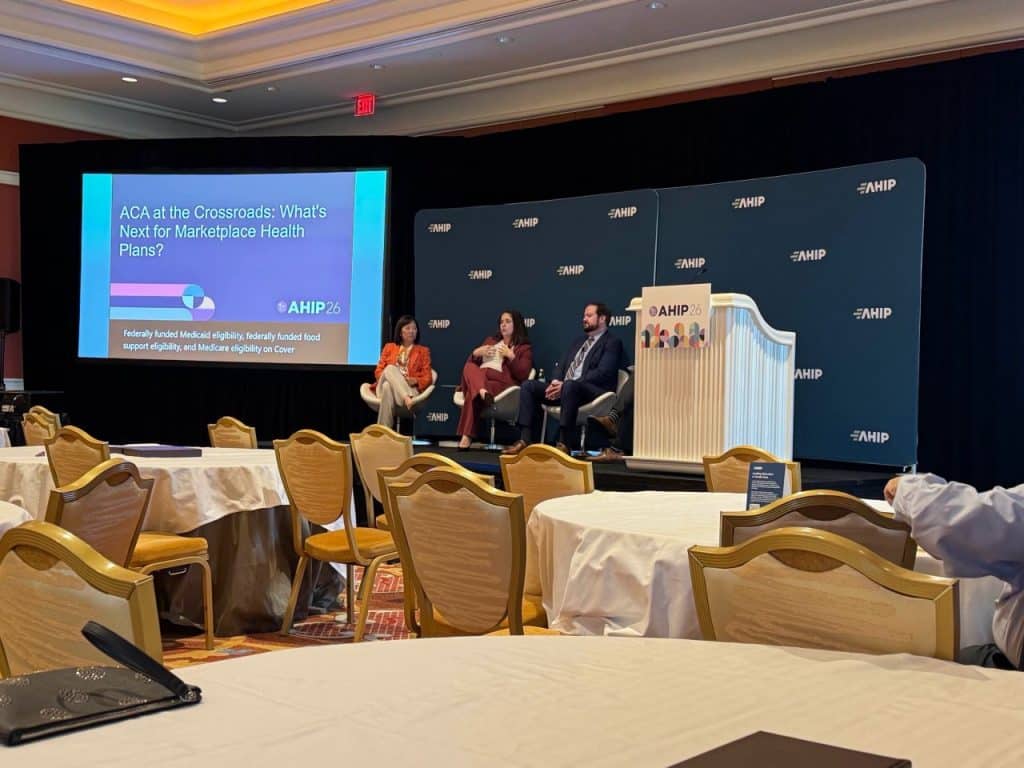
That perspective echoed themes discussed during AHIP’s ACA Marketplace session, where speakers acknowledged growing volatility in the market while also reinforcing that the Marketplace has become an established coverage pathway rather than a temporary policy experiment.
“We have the Marketplace now, I believe, as a really established coverage path. However, the lack of stability and the volatility makes it so that you see issuers now nervous or pulling out.” – Annie Lee, President and CEO of Colorado Access
Annie H. Lee, JD, Colorado Access | Jessica Altman, Covered California | Randy Pate, Randolph Pate Advisors, LLC
Market disruption often creates openings for organizations willing to invest while others pull back. New market entrants, regional carriers, and plans with strong local provider relationships may find opportunities to grow membership and strengthen their position in the Individual market.
Joe challenged the common assumption that ICHRA simply shifts members from one coverage type to another. “At face value, it really looks like this will cannibalize other products. But, I would say it would actually increase the balance of membership, so that carriers won’t lose their membership to other competitors.”
The Organizations That Prepare Today Will Be Better Positioned Tomorrow
“I think we’ve got to face the idea that this moment of uncertainty is permanent. And that the amount of uncertainty that we’re experiencing right now is probably the least amount of uncertainty that we’ll all be facing for the rest of our careers.” – Nancy Wise, President and Founder, Spring Street Exchange
ICHRA may still be in the early stages of adoption, but the forces driving interest in the model continue to strengthen. Rising employer healthcare costs, workforce fragmentation, growing consumer expectations, and continued pressure on traditional group coverage are unlikely to disappear.
AHIP 2026 reinforced that the future of ICHRA will be shaped by organizations willing to prepare for where the market is headed rather than where it has been.