Everything is becoming more expensive, so it’s not a surprise that employer-sponsored healthcare costs and premiums are growing exponentially.
But the question arises: who bears the brunt of these increasing costs?
The short answer is everyone. Employers, health plans, and especially employees are all impacted by rising employer-sponsored healthcare costs.
The 25th Employer Health Benefits Survey (EHBS) provides a snapshot of the nearly 153 million individuals enrolled in employer-sponsored coverage from January to July of 2023. According to the Kaiser Family Foundation (KFF), the average annual premium for employer-sponsored health coverage in 2023 was $8,431 for single coverage and $23,968 for family coverage. 2023 saw a 7% increase from the previous year; however, costs between 2021 and 2022 did not increase.
Increasing premium payments are caused by rising plan costs. A recent report by Aon projects that the average cost of employer-sponsored health plans is expected to grow an additional 9% next year if significant cost-cutting strategies aren’t implemented. This increase could bump employer-sponsored plan costs past $16,000 per employee in 2025.
Let’s go over how rising costs will impact employees, employers, and health plans.
Impact on Employees
Employees are increasingly shouldering a significant portion of their healthcare costs. On average, employees contribute $1,401, or 17%, of the premium for individual coverage and $6,575, or 29%, for family coverage.
The financial burden is even higher for employees of small businesses, where employees contribute nearly $2,500 more toward family premiums compared to those at larger companies. Coverage is becoming unaffordable for many.
Impact on Employers
There is no federal mandate dictating the minimum employer contribution towards health insurance, although many states require at least a 50% contribution. In 2023, employers on average covered 83% of the premium for individual coverage and 71% for family plans. The ideal contribution percentage varies by industry, company size, and the health benefits offered. Employers need to conduct ongoing and extensive research to remain competitive and profitable.
As employees demand more comprehensive coverage and benefits, the financial and administrative strain grows for employers. Many are considering offering an Individual Coverage Health Reimbursement Arrangement (ICHRA) to provide employees with more coverage options while limiting costs.
Impact on Health Plans
The search for cost-effective alternatives to traditional group markets is intensifying.
With more pervasive health needs across the US population (e.g., an aging population, demands for GLP-1 coverage, and rising pharmaceutical costs), health plans and employers are struggling to balance increasing needs, costs, and employee expectations. Forward-thinking health plans recognize the concerns of both employees and employers and are exploring alternative coverage options. Market volatility and user demand is driving health plans to shift towards government-sponsored alternatives like an ICHRA.
ICHRA Gaining Traction as Employer-Sponsored Alternative
Under the ACA, applicable large employers (ALEs) are mandated to provide health insurance that meets specific coverage and affordability standards, or face penalties. However, many employees find themselves with technically “affordable” employer-sponsored coverage that’s financially out of reach.
Here’s how ICHRA satisfies the employer mandate while keeping healthcare costs low:
Minimum Essential Coverage (MEC): ICHRAs can be structured to ensure that employees purchase individual health insurance that meets MEC standards. By offering an ICHRA, employers can ensure their contributions help employees obtain qualifying health coverage.
Affordable Coverage: Employers can design ICHRAs to offer sufficient reimbursement amounts, making health coverage affordable for employees under the ACA guidelines. The affordability of an ICHRA is calculated based on the lowest-cost silver plan available in the employee’s area, minus the ICHRA contribution, ensuring compliance with affordability requirements.
Minimum Value: ICHRAs indirectly meet the minimum value requirement by facilitating the purchase of qualified health plans (QHPs), many of which meet or exceed the coverage threshold required by the ACA.
The benefits that ICHRA offers to both employees and employers has led to ICHRA growing year over year. Since 2023, ICHRA adoption has surged by 30%, with a projected growth rate of 255% by 2025.
Figure 1 Growth in Popularity of ICHRA and QSEHRA; “2023-2024 Growth Trends” by the HRA Council
ICHRA began outperforming the Qualified Small Employer Health Reimbursement Arrangement (QSEHRA) in growth as early as 2021. This surge in popularity is largely due to ICHRA’s universal appeal. ICHRA is not limited by business size. Rather, the flexibility of defined contributions across multiple employee classes allows for ICHRA to be a viable option for businesses struggling with traditional employer-sponsored coverage.
As more employers and employees demand access to affordable health care coverage, we see health plans starting to design their ICHRA-specific plans offerings.
3 Reasons Why Health Plans Support ICHRA
ICHRA is gaining traction among health plans for its versatility and strategic advantages. Here are three key reasons why health plans are increasingly supporting ICHRA:
Expanded Member Market: With ICHRA, health plans can offer coverage to employees at small businesses that are priced out of the traditional employer-sponsored coverage. This expansion allows health plans to expand their membership to new groups.
Strengthening the ACA Market: The ACA Marketplace has shown growth and stability for several years, fueled by increases in advanced premium tax credits (APTCs) and enrollment numbers. With more states adopting the state-based marketplace (SBM) model, health plans have greater freedom to offer ACA incentives and expand accessibility programs previously constrained under the Federal Facilitated Marketplace (FFM). ICHRA represents a significant advancement in ACA market development.
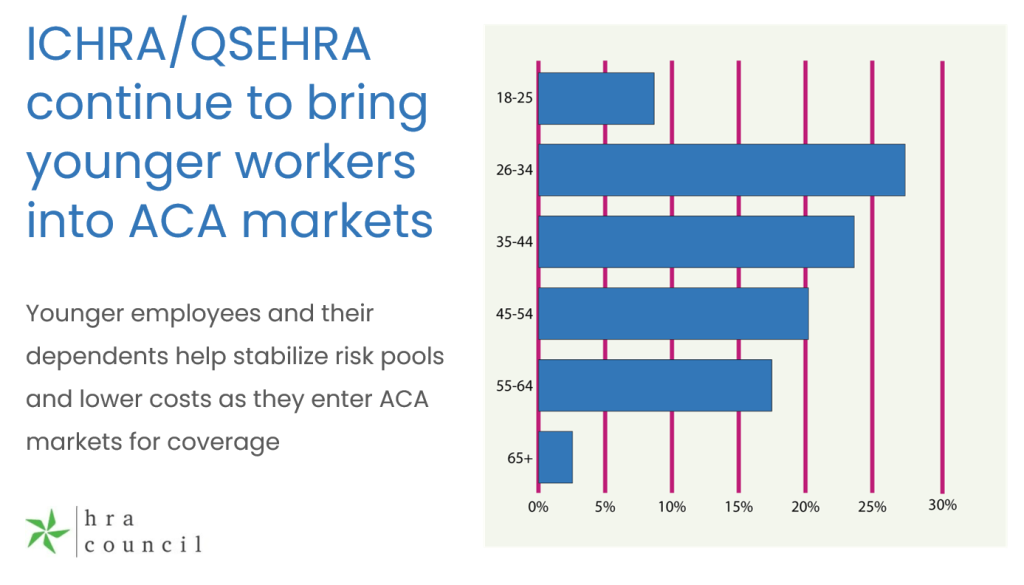
Stabilizing ACA Risk Pools: By transitioning individuals from group coverage to QHPs, health plans are effectively reducing the average age of the ACA market. This influx of younger and healthier individuals helps stabilize ACA risk pools and reduce premium costs.
Figure 2 ICHRA Stabilizes ACA Risk Pools, “2023-2024 Growth Trends” by the HRA Council
Get Started with ICHRA by Leveraging Existing Technology
Supporting ICHRA might seem daunting. But for health plans already offering QHPs or planning to enter the ACA market, the framework is already in place.
Brokers currently handle a significant portion of ICHRA enrollments, making it essential for health plans to provide them with effective technology. This technology should facilitate plan shopping, help set up employer offerings, and manage client enrollments.
Successful ICHRA shopping and enrollment platforms mirror off-exchange offerings, simplifying the process by providing a unified method to enroll in QHPs. This not only streamlines enrollment but also equips employees with the tools they need for a guided shopping experience that ensures they choose the plan that best fits their needs.
The data exchange process between CMS and brokers for ICHRA and off-exchange ACA plans remains consistent. However, a major challenge for health plans supporting ICHRA is the need to collaborate with Benefits Technology (BenTech) agencies, ICHRA Administrators, and other Third Party Administrators (TPAs). Establishing a new layer of communication is crucial to addressing the specific needs of employees and employers effectively.
Softheon, in partnership with our sister brand W3LL, facilitates the connection between health plans and ICHRA administrators. As a trusted partner already managing over 100 health plans, we can link health plans with our W3LL network of ICHRA administrators, reducing time to market for ICHRA offerings.
Figure 3 W3LL and Softheon Work Together to Connect Health Plans to BenTech
In addition to BenTech integrations, Softheon offers an all-in-one solution for the enrollment and management of ICHRA coverage.
Shopping & Enrollment: Softheon’s ICHRA platform mirrors our gold-standard off-exchange portal, providing brokers and individuals with guided shopping tools to make informed coverage choices. Additionally, Softheon streamlines operations by automatically transferring 834 enrollment files between ICHRA Admins and CMS, speeding up member access to coverage and reducing manual reconciliation for health plans.
Broker Management: Our comprehensive broker portal enables brokers to quote, enroll, and manage their clients seamlessly. It integrates with agencies’ broker management solutions, allowing health plans to be featured across a broader book of business.
Payment Collection: Softheon supports a variety of payment methods, enabling members to easily manage initial binders, monthly premiums, and renewals. In partnership with W3LL, these payment options are tailored to fit BenTech’s specific processes.
Employee Transition: If an employee leaves their employer but retains their health plan, Softheon facilitates a smooth transition by processing a disenrollment transaction. This ends the ICHRA payment account and switches the member to direct billing as an off-exchange individual, thus minimizing coverage lapses.
Reporting: Softheon delivers detailed reports on enrollments and member activity to support health plans’ strategic decisions.
What Type of Health Plans Could Benefit the Most from ICHRA?
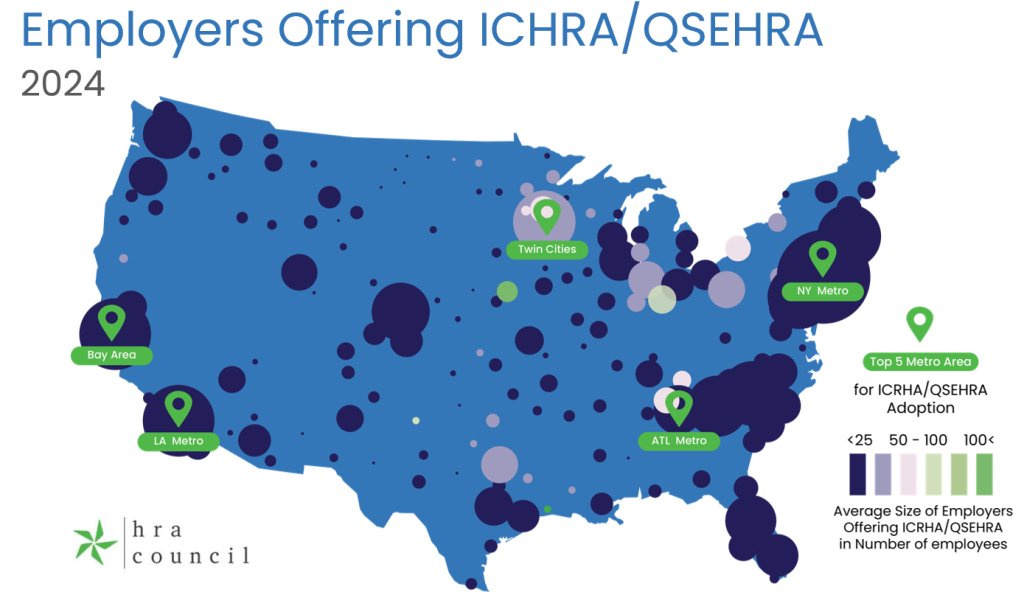
Densely Populated Geographic Areas: Urban centers see a higher concentration of ICHRA plans due to the number of eligible businesses.
Figure 4 ICHRA Adoption Rises in Urban Centers, “2023-2024 Growth Trends” by the HRA Council
Community-Oriented Health Plans: Local small businesses benefit significantly from plans that support community-specific needs.
Plans with a Strong ACA Presence: Leveraging existing technology and infrastructure to support ICHRA can enhance service offerings and market reach. ICHRA also helps bring younger workers in the ACA market to lower risk pools and premium payments.
As the traditional employer-sponsored insurance market continues to evolve under economic pressures, ICHRA stands out as a flexible and cost-effective alternative, promising a new landscape for health coverage that benefits employers, employees, and health plans.