February 2026 | By Softheon
Key takeaways for health plans:
- Scale ACA and employer-funded growth (including ICHRA) without outpacing capital, infrastructure, or cash flow.
- Reduce administrative cost and member confusion through better governance, digital self-service, and high-touch engagement.
- Balance mission and margin by operationalizing clinical data, strengthening retention, and using technology (including AI) to support sustainable growth.
Provider-sponsored (PSHP) and provider-aligned health plans are facing more pressure than ever. Growth is possible, but it brings real tradeoffs around cost, complexity, and the member experience. For health plan leaders, the question is no longer whether to grow, but how to do it without losing control.
- Provider-sponsored health plan: Provider-sponsored plans are owned and operated by health systems, with financial and operational accountability.
- Provider-aligned health plan: Provider-aligned plans are traditional carriers or joint ventures that partner closely with providers but do not shift full ownership or risk to the provider.
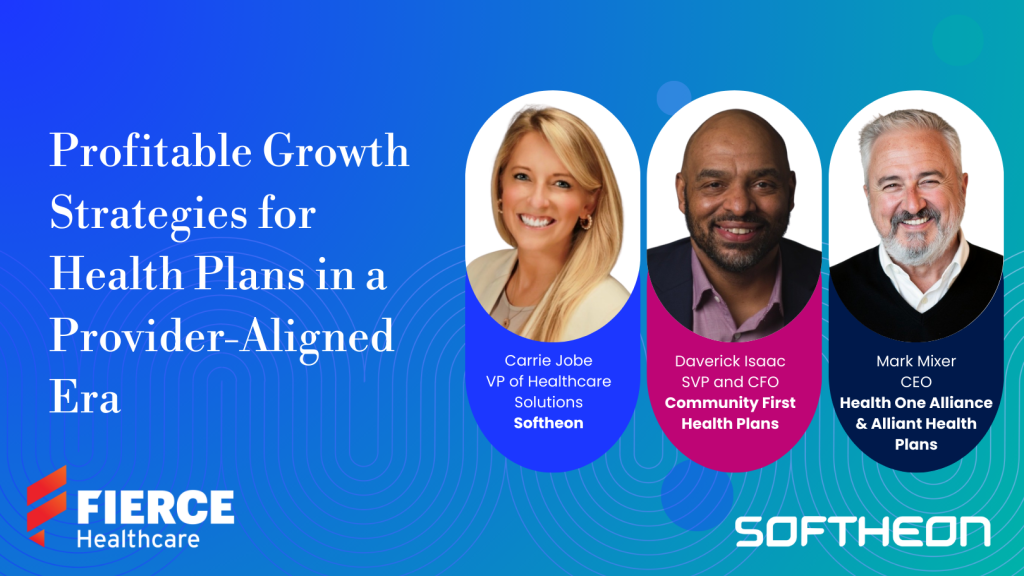
We sat down with Mark Mixer, Chief Executive Officer of Health One Alliance and Alliant Health Plans, and Daverick Isaac, Senior Vice President and Chief Financial Officer at Community First Health Plans, two leaders steering provider-aligned health plans, to talk through what they’re seeing on the ground. Moderated by Carrie Jobe and hosted by Fierce Healthcare, the conversation covered what works, where provider-aligned struggle, and how plans can scale without creating new risk.
This Q&A recap highlights key moments from the discussion in Mark and Daverick’s own words, from operational pressure points to member trust, employer-funded models like Individual Coverage Health Reimbursement Arrangements (ICHRA), and the role of tech and governance.
Watch the full recording here!
Thanks to Mark, Daverick, Carrie Jobe, and Fierce Healthcare for a thoughtful and timely conversation.
Where Provider-Aligned Plans Win — and Where the Advantage Breaks
Q: What are the real advantages provider-aligned plans bring to the market, and where do those advantages start to get tested as you grow or expand?
Mark grounded the conversation in what provider-aligned plans often point to first: Mission alignment, tighter integration with care delivery, and access to clinical and utilization data that traditional carriers lack. In the early stages, that alignment can create differentiation, particularly when plans are close to providers and understand how care is delivered.
“That enables you to have a much different conversation than when you’re at odds, like in many for-profit or shareholder-owned companies, which have a very different mission to fulfill.” – Mark Mixer
However, those advantages do not scale automatically. As PSHPs grow or expand into new markets, the benefits of alignment are tested by operational reality. Data access alone does not create value. The advantage only holds if plans can operationalize that data across enrollment, billing, payments, and ongoing member engagement.
As scale increases, complexity compounds. Systems that worked at smaller membership levels begin to strain, and gaps between insight and execution become more visible.
How Member Confusion Undermines Trust, Retention, and Cost
Q: Where is member confusion highest today, and how does that confusion impact trust, retention, and cost for the plan?
“I think it would be incredulous to suggest that we’ve built something that’s easy for people to consume and understand. In fact, we’ve done a really good job of making it complicated and hard for people to understand.” – Mark Mixer
Mark was candid in acknowledging that healthcare remains difficult for consumers to understand, even when plans make real efforts to simplify the experience.
He noted that frustration is often unavoidable, not because plans don’t care, but because of the underlying cost and complexity of care. PSHPs may approach these situations with greater empathy due to their proximity to clinical settings, but confusion still shows up across all plan types.
Despite having more communication channels than ever before, from texting to portals to interactive voice response (IVR), Mark emphasized that members still fall through the cracks. For PSHPs, that means recognizing when digital access alone isn’t enough and stepping in more directly.
Daverick shared that for Community First, confusion became especially visible during their rapid growth in the Marketplace. Shifting federal narratives around subsidies created uncertainty for members during enrollment, requiring extensive re-education and outreach.
“We’ve had to do a lot of re-communicating to people that there are still subsidies available.” -Daverick Issac
As new members came from national, for-profit plans, Community First leaned heavily on brokers and internal resources to help members navigate healthcare.gov and understand their options. Both leaders agreed that confusion is not just a member experience issue. It quietly drives operational cost, service volume, and retention risk.
Balancing High-Touch Care Models with Digital Self-Service in Provider-Aligned Plans
Q: How do you stay high-touch and trusted while still encouraging digital self-service that keeps costs under control?
Daverick described this challenge as a constant balancing act, particularly for nonprofit, community-based plans. Members expect personal, local support, but rising admin costs make it impossible to rely solely on high-touch service.
At Community First, that balance starts with keeping member services local, so when members call, they’re speaking with someone in their own community. At the same time, the plan has invested heavily in its member portal, texting, and carefully governed digital tools to resolve issues without requiring a phone call.
The key is making sure members understand those tools exist and feel comfortable using them.
Mark reinforced that successful balance depends less on the tools themselves and more on how organizations define outcomes internally. Rather than measuring call length or speed, his teams focus on whether problems are solved. “We don’t track how long they’re on the phone. We track whether they solved the problem with one call.”
Scaling Growth Without Outpacing Capital, Infrastructure, or Cash Flow
Q: How do you plan for growth when higher premium volume also means higher claims exposure? What lessons have you learned about scaling responsibly without outpacing capital or infrastructure?
Growth rarely follows the “ideal” curve health plans are taught to expect. In theory, steady growth is manageable. In practice, PSHPs often experience uneven surges driven by pricing dynamics and regulatory structure, especially in the ACA.
Mark described how unexpectedly low premiums can quickly push a plan to the top of exchange listings, triggering rapid membership growth whether the organization is ready for it or not. That kind of growth creates immediate downstream pressure, from medical management to client services, and forces plans to deal with the aftermath in real time.
More importantly, premium growth does not sit quietly on the balance sheet. Claims move quickly, providers expect timely payment, and PSHPs often lack the balance sheet flexibility of national carriers. That makes cash flow one of the most critical and fragile elements of growth. “You want to pay claims out as quickly as possible to satisfy that provider, but that also strains your cash flow,” explained Mark.
Daverick echoed that reality from recent experience at Community First. Even when growth is anticipated and planned for, actual enrollment often exceeds projections, forcing rapid resets across capital planning, staffing, and operations.
Growth, he noted, brings excitement and anxiety at the same time. While it is ultimately positive, it requires constant recalibration and fast decision-making to avoid overextension.
“You can grow yourself into a lot of loss.” – Daverick Issac
As Community First expanded beyond its historic Medicaid and child-focused population into the Marketplace, Daverick highlighted the need to evolve internal governance, policy, and workforce mindset. What works at smaller scale no longer holds as membership grows and populations diversify. Both leaders agreed there is no single lever that makes growth safe or simple.
How Sponsored Payment Programs Support Retention and Long-Term Sustainability
Q: How does your sponsored payment program function day to day, and how does it change the way you think about engagement, member loyalty, and long-term sustainability?
Community First’s sponsored payment program was not an add-on, but the original entry point into the Marketplace. The program launched four years ago in partnership with University Health, moving a small population from a medical services program into subsidized Marketplace coverage, with the remaining premium fully sponsored by the health system.
From the start, the goal was twofold: Reduce taxpayer burden while getting more people into comprehensive health coverage. Over time, the program scaled and became deeply integrated across the health system and health plan.
What stood out in Daverick’s description was how operationally normal the program is for members. Sponsored members are not treated differently, do not experience a separate engagement path, and are supported through the same services and touchpoints as all other members. The distinction exists largely behind the scenes, in the financial and administrative workflows.
That consistency, Daverick noted, has driven unusually strong retention. Members stay enrolled, and in many cases, continue coverage even after their financial situation improves and sponsorship ends. “Our member retention is almost at 95%.”
As the population has grown, the program has also strengthened the relationship between the health system and the plan. By transitioning eligible individuals into coverage, Community First can return appropriate reimbursement to the health system for care that would otherwise go uncompensated.
Daverick described the model as a win across the board: for members who gain stable, high-quality coverage; for the health system, which sees improved reimbursement; and for the broader community, which benefits from a more sustainable approach to coverage.
How ICHRA Fits into Provider-Sponsored Growth
Q: How do you see ICHRA and other employer-funded options complementing government-sponsored markets rather than competing with them?
Mark framed ICHRA as part of a broader shift away from traditional employer-sponsored insurance models that have remained largely unchanged for decades. In his view, employer-funded approaches like ICHRA reflect a growing recognition that employers do not want to be insurance experts and are looking for more predictable ways to support coverage.
He compared ICHRA’s potential to earlier shifts in retirement benefits, where defined contribution models gave individuals more control while stabilizing employer budgets. For employers, the appeal is less about disruption and more about relief: stepping out of the insurance business while still offering meaningful coverage.
“[ICHRA] enables employers to get out of having to be in the insurance business, stabilizes their funding, and creates a win for employers, employees, and finance leaders.” – Mark Mixer
At the same time, Mark was careful not to oversell ICHRA. He emphasized that it is not a silver bullet and is unlikely to fully replace traditional group coverage, particularly for large employers. Instead, he described it as an option that will continue to grow over time, especially for small employers facing rising premiums and rigid contribution requirements.
For PSHPs, ICHRA expands the coverage toolkit. It creates additional pathways to reach members without displacing government-sponsored markets, allowing plans to diversify distribution while responding to what employers are actively asking for.
Q: What makes employer-funded models like ICHRA attractive for provider-aligned plans, and what operational challenges tend to surface first?
From Daverick’s perspective, ICHRA creates a way to connect directly with employer groups, expand into new populations, and offer coverage options that better fit local needs.
He noted that for Community First, ICHRA opens the door to designing networks that are appropriate for employee populations, rather than defaulting to large national networks that drive up cost. At the same time, he was candid about the operational lift required. For plans new to ICHRA, the first challenge is building the infrastructure to support multiple employer groups while educating brokers and employers.
Mark added an important caution from the administrative side. He outlined three distinct ways health plans can engage with ICHRA:
- Simply promoting it
- Offering attractive individual products for ICHRA participants
- Fully administering ICHRA programs.
“If you think ICHRA administration is easy, I would love to have a conversation with you. There is nothing simple about administering an ICHRA.” – Mark Mixer
Despite that complexity, Mark noted that once processes are built and governance is in place, the model can be sustainable. He also emphasized the importance of aligning provider finance and contracting teams early, since shifts from traditional group coverage to individual plans can impact reimbursement if not managed intentionally.
The shared takeaway from both leaders was pragmatic: ICHRA is not optional to understand, but it must be approached deliberately. For provider-aligned plans, success depends on clear strategy, operational readiness, and strong coordination across finance, contracting, and distribution.
Where AI Delivers Value for Provider-Aligned Health Plans
Q: Where is AI actually delivering value today, and what has to be true from a governance and risk standpoint before it can go further?
AI is not as a future-state technology, but as something already embedded in day-to-day work.
In many cases, its presence is subtle. Productivity gains are happening whether organizations explicitly label them as “AI” or not. Tasks that once took hours or days, such as drafting presentations or written materials, can now be completed in minutes.
From Mark’s perspective, any tool that meaningfully improves productivity is worth paying attention to. But he was clear that governance, not capability, is the limiting factor. “Governance, I think, is still the key to this. That drives the cornerstone of the infrastructure.”
He drew a parallel to the early days of managed care, noting that disruptive systems often move faster than organizations are prepared for. In his view, AI will follow a similar path, with lessons learned through experience rather than perfect foresight. While he sees long-term potential for clinical efficiency, he acknowledged that meaningful adoption will take time and careful guardrails.
Daverick reinforced the importance of governance from an operational standpoint. At Community First, AI access is tightly controlled. Tools are evaluated through formal security and compliance processes before being approved, and most usage today is limited to administrative functions.
He described AI as unavoidable but emphasized its most immediate value for plans under constant administrative cost pressure. “It’s a great tool from an administrative perspective.”
For Daverick, AI’s strength lies in reducing the time and effort required for routine, non-clinical work. At the same time, he expressed caution around judgment-based use cases. Inconsistent outputs across tools and the absence of clear regulatory guidance make it early to rely on AI for decision-making.
AI belongs at the table for PSHPs, particularly as a lever to manage administrative cost. But progress depends on strong governance, clear boundaries, and continued oversight, especially as regulatory frameworks continue to evolve.
Bonus Round: The New Future of Provider-Sponsored Plans
Daverick described a future where provider-aligned plans become more relevant, not less. In his view, growing frustration with large, national, for-profit carriers is pushing employers, members, and states to look for alternatives that feel accountable, local, and personal.
He emphasized that PSHPs are increasingly being asked to play a cost-containment role while still delivering a higher-touch experience. That creates both opportunity and pressure. As demand grows, plans will need to manage the same balancing act discussed throughout the conversation: Using technology to scale while preserving trust and local connection.
“I think we’re going to become more popular in the next five to ten years than we’ve ever been, because people are seeking us out.” – Daverick Issac
This shift will not replace national carriers outright. Instead, he sees a redistribution of where different plan models make sense, with local, provider-aligned plans playing a larger role than they have historically.
Mark built on that perspective by returning to a theme from earlier in the discussion: Alignment matters more than innovation alone. While new tools and technologies generate attention, he argued that long-term success depends on operational execution, local care delivery, and pricing discipline.
He also cautioned that true alignment requires maturity on both sides of the organization. Health systems must understand how plan decisions affect reimbursement and utilization, just as plans must understand how their actions ripple through provider operations. “Alignment beats innovation every single time.”
Thank you again to our panelists, Fierce Healthcare, and our own Carrie Jobe for facilitating this important conversation. To learn more about Softheon’s offerings for provider-sponsored health plans, visit our website. And click here to watch the full discussion.
FAQ: Provider-Aligned and Provider-Sponsored Health Plans
What makes provider-sponsored health plans structurally different from traditional carriers?
Provider-sponsored health plans are owned or backed by health systems, which means they operate with tighter alignment between care delivery, network strategy, and financial performance. Unlike traditional carriers, PSHPs often balance insurance margins with clinical outcomes, provider incentives, and system-wide cost control.
Why are more health systems reconsidering the Individual market right now?
With ACA markets stabilizing and membership models diversifying, many provider-sponsored plans see the individual market as a strategic growth channel. It offers opportunities to retain patients within the system, diversify revenue streams, and extend value-based care models beyond employer groups.
Where do provider-sponsored plans struggle most as they scale?
The biggest challenges typically emerge in operations: billing and payments, reconciliation, compliance, broker enablement, and managing growth without overextending capital. Scaling membership often exposes gaps in infrastructure that were manageable at smaller volumes.
How do provider-sponsored plans balance affordability with long-term sustainability?
Successful plans focus on disciplined pricing, operational efficiency, and smarter distribution. This often means investing in automation, leveraging provider data more effectively, and designing products that align clinical cost management with competitive premiums.
What role does ICHRA play in growth strategies for provider-sponsored plans?
ICHRA allows PSHPs to access employer-funded lives without taking on traditional group risk. It creates a new distribution pathway that complements ACA and government programs, especially for plans looking to expand into employer markets with lower administrative overhead.
How are provider-sponsored plans using AI in practice today?
Most real-world AI adoption is focused on operations, not clinical decision-making. Plans are using AI to automate enrollment workflows, improve billing accuracy, support customer service, detect anomalies in payments, and reduce manual work across core administrative processes.
What separates high-performing PSHPs from those that stall?
High-performing plans treat operations as a growth lever, not just a cost center. They invest early in scalable infrastructure, build strong broker and partner ecosystems, and align technology decisions directly with financial and clinical strategy.
Why are more health systems reconsidering the Individual market right now?
With ACA markets stabilizing and membership models diversifying, many provider-sponsored plans see the individual market as a strategic growth channel. It offers opportunities to retain patients within the system, diversify revenue streams, and extend value-based care models beyond employer groups.
Where do provider-sponsored plans struggle most as they scale?
The biggest challenges typically emerge in operations: billing and payments, reconciliation, compliance, broker enablement, and managing growth without overextending capital. Scaling membership often exposes gaps in infrastructure that were manageable at smaller volumes.
How do provider-sponsored plans balance affordability with long-term sustainability?
Successful plans focus on disciplined pricing, operational efficiency, and smarter distribution. This often means investing in automation, leveraging provider data more effectively, and designing products that align clinical cost management with competitive premiums.
What role does ICHRA play in growth strategies for provider-sponsored plans?
ICHRA allows PSHPs to access employer-funded lives without taking on traditional group risk. It creates a new distribution pathway that complements ACA and government programs, especially for plans looking to expand into employer markets with lower administrative overhead.
How are provider-sponsored plans using AI in practice today?
Most real-world AI adoption is focused on operations, not clinical decision-making. Plans are using AI to automate enrollment workflows, improve billing accuracy, support customer service, detect anomalies in payments, and reduce manual work across core administrative processes.
What separates high-performing PSHPs from those that stall?
High-performing plans treat operations as a growth lever, not just a cost center. They invest early in scalable infrastructure, build strong broker and partner ecosystems, and align technology decisions directly with financial and clinical strategy.